

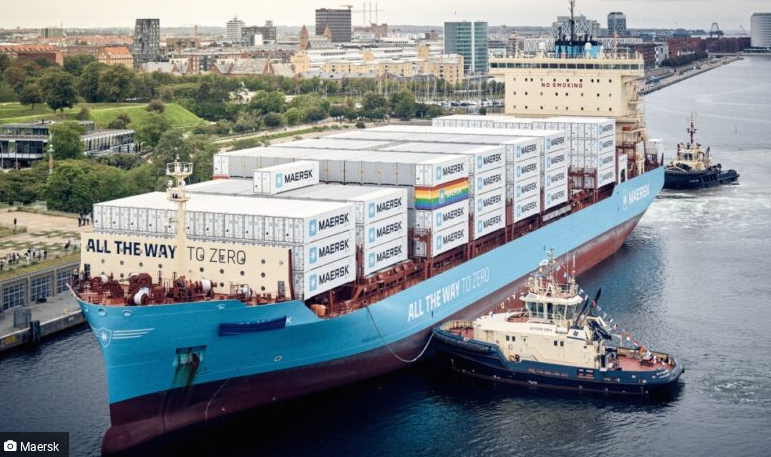
Maersk has raised its full-year earnings guidance for the third time this year, with the Danish shipping giant continuing to benefit from extraordinary freight rates, resilient cargo demand and widespread supply chain disruption.
The Copenhagen-headquartered group now expects underlying EBITDA of between $14bn and $14.5bn for 2026, up from its previous forecast of $10.5bn to $12.5bn. Its underlying operating profit forecast has been lifted to between $8bn and $8.5bn, while free cash flow is expected to exceed $3bn.
The upgrade follows a strong third quarter in which revenues climbed 27% year on year to $18.1bn, while EBITDA surged from $2.7bn to $4.7bn. Operating profits more than doubled to $3.3bn.
The ocean division generated operating profits of $2.6bn, compared with $567m a year earlier, as elevated freight rates more than compensated for marginally lower volumes.
“Despite continued geopolitical uncertainty and disruptions, global trade has remained remarkably resilient,” said Maersk chief executive Vincent Clerc.
Clerc highlighted growing cargo demand linked to investments in electrification, energy and artificial intelligence infrastructure, with Maersk’s fleet operating at 96% utilisation.
Severe typhoons across Asia also contributed to the earnings surge, creating congestion that pushed global average port waiting times to 16.6 hours, the highest since January 2023. The Shanghai Containerised Freight Index averaged 46% higher in the third quarter than in the preceding three months.
However, the results have not impressed everyone.
Analysts at SEB noted that the earnings upgrade, while substantial, fell short of some buy-side expectations. Third-quarter EBITDA of $4.71bn was below the bank’s $5.56bn forecast and the $5.17bn consensus, with the ocean division responsible for the shortfall.
Container shipping analyst Lars Jensen also highlighted Maersk’s relatively weaker performance against its peers. The carrier’s ocean operating margin of 20.6% compared with 21.6% at Ocean Network Express and 28.8% at COSCO’s container division, including OOCL.
Maersk’s volumes declined 0.8%, against growth of 4.5% at both ONE and COSCO.
The wider container market is entering the final quarter of the year with an increasingly pronounced divergence between its principal east-west trades.
Alphaliner analysis shows that the transpacific is generating approximately five times more spot revenue per nautical mile than the Asia-Europe trade via the Cape of Good Hope.
Freightos currently assesses Asia-US west coast rates at $8,340 per feu and east coast rates at $9,911, levels that remain extraordinarily elevated by historical standards.
Yet the first signs of a correction are appearing.
Drewry’s latest World Container Index fell 3% to $4,429 per feu, with Shanghai-Los Angeles rates dropping 6% to $7,514 and Shanghai-New York declining 5% to $9,631.
Asia-Europe rates have been more stable, with Shanghai-Rotterdam edging up 1% to $3,686 and Shanghai-Genoa unchanged at $4,151.
Drewry expects further pressure on transpacific rates as US imports are forecast to decline 11% month on month in November. Carriers are responding with blank sailings, although the sheer volume of capacity deployed on the Pacific is becoming increasingly difficult to absorb.
The longer-term outlook is arguably more troubling.
Splash reported last week that the containership orderbook had reached 15.12m teu, equivalent to 43.9% of the existing fleet, while the accelerating return to Suez threatens to release substantial additional effective capacity.
Sea-Intelligence estimates that around 60% of deployed Asia-Europe capacity is already operating, or scheduled to operate, via Suez, with further normalisation expected during the first quarter of 2027.
Related Ads
Leave feedback about this
You must be logged in to post a review.