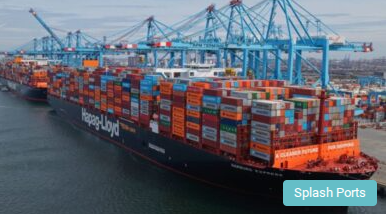
Hapag-Lloyd has agreed to acquire a 25% stake in APM Terminals Maasvlakte II in Rotterdam, securing long-term capacity at one of the key European hubs in its Gemini Cooperation with Maersk.
The investment will be made through the German carrier’s terminal arm, Hanseatic Global Terminals. APM Terminals will retain operational control of the highly automated facility. Financial terms were not disclosed and the deal remains subject to regulatory approvals.
The transaction comes as Maersk’s port operating arm pushes ahead with a major expansion at Maasvlakte II, adding 1,000 m of deepsea berth to take the total to 2,000 m, alongside additional yard space, four rail tracks, automated terminal tractors and other automated equipment. Capacity is expected to rise towards 5.4m teu a year.
The expansion dates back to a more than €1bn ($1.17bn) agreement with the Port of Rotterdam Authority covering roughly 47.5 ha and around 2m teu of additional capacity. Construction formally moved into the main expansion phase last year, with the first new capacity targeted for completion by the end of 2026.
Maasvlakte II has been operational since 2015 and was developed as a fully automated terminal. Hapag-Lloyd said the investment would give the carrier more secure automated handling capacity at Rotterdam while further building out HGT’s network of terminal investments.
The deal also tightens the infrastructure ties underpinning Gemini, the east-west network operated jointly by Hapag-Lloyd and Maersk. APM Terminals described Maasvlakte II as a critical terminal for the alliance.
Hapag-Lloyd has been moving quickly to expand its terminal portfolio. Splash reported in June that HGT agreed to take 20% of Eurogate Container Terminal Hamburg and double its stake in Tangier Med’s TC3 terminal from 10% to 20%.
The Rotterdam investment follows a broader infrastructure push around Maasvlakte II. Splash reported last month that the Port of Rotterdam is widening the Yangtzekanaal serving APMT 2 and Rotterdam World Gateway to enable two-way traffic by containerships of up to 24,000 teu as both terminals expand.