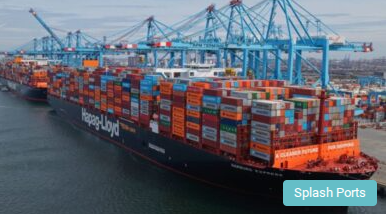
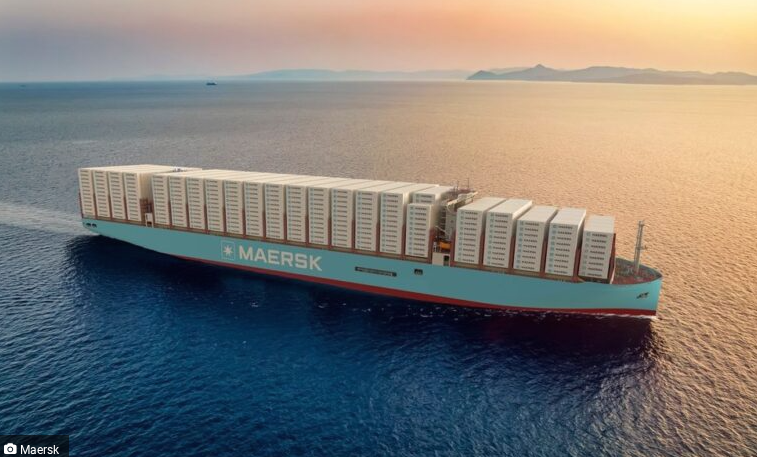
Maersk appears ready to tear up one of the defining tenets of its strategy this decade, abandoning its long-standing containership capacity ceiling as Vincent Clerc prepares the Danish carrier for renewed fleet growth.
Throughout container shipping’s extraordinarily profitable 2020s, Maersk repeatedly insisted its fleet would remain broadly within a 4m to 4.4m teu band, with newbuildings principally replacing older tonnage rather than adding capacity.
That discipline has already started to disappear. Maersk’s operated fleet is now above 4.7m teu, comfortably beyond its former ceiling, while CMA CGM is closing in rapidly on second place in the global liner rankings and has a substantially larger orderbook.
Comments accompanying Maersk’s second-quarter results last week suggest CEO Clerc is ready to respond. The company told investors it will “ensure that we have the capacity to grow”, having reached the limits of what can be extracted from its current fleet. Maersk has got its timing wrong.
Analysts at Linerlytica reckon this could herald a new ordering phase, noting that Maersk’s annualised fleet growth since 2018 has been just 2%, compared with 11.7% among key rivals.
The consultancy argues that eight years of restraint have left Maersk needing additional tonnage at precisely the moment the global containership orderbook has surged to fresh records.
Not everyone expects a huge newbuilding spree. Drewry managing director Philip Damas told Splash that Maersk is likely to pursue two objectives: replacing ageing vessels, partly to meet tightening environmental requirements, and adding more ships suited to fast-growing intra-regional trades.
Drewry counts 46 Maersk ships of 15,000 teu or above on order, but only seven vessels of 6,000 teu or below.
Damas also said he saw some merit in Maersk’s previous caution.
“Not ordering excessive capacity in recent years, which most other large carriers did, will expose Maersk to a lower risk of overcapacity in late 2027-2029,” he said.
Ordering now, however, would mean paying significantly higher prices. Damas suggested Maersk could instead exploit the next downturn by buying large containerships cheaply from owners caught with too much capacity.
Andy Lane from Singapore’s CTI Consultancy pointed out that Maersk already has an orderbook representing 25% of its current capacity, which will be fractionally offset by some scrapping.
“With an additional 25% of the existing global fleet hitting the water in 2027-2028, with organic growth of 5% demand per year, which in terms of teu*nautical miles will effectively be less with more Suez services, the industry is not heading to a happy place,” Lane warned.
Shipping analyst Lars Jensen from Vespucci Maritime similarly cautioned that abandoning the ceiling need not automatically translate into a massive ordering programme.
“It might not necessarily entail a large ordering spree, but could also indicate a more aggressive approach to taking vessels in on charter,” Jensen said.
That is already happening. Alphaliner analyst Jan Tiedemann said Maersk has been chartering “very aggressively” recently, something he sees as evidence the carrier misjudged the newbuilding market several years ago.
“I would say that Maersk has got its timing wrong,” Tiedemann said. “They have ordered large newbuildings too late and too few, and they need one or two dozens more.”
Tiedemann also pointed to fleet renewal. Maersk was an early mover into ultra-large ships, meaning some of its biggest vessels will be among the first of their generation requiring replacement in the early 2030s.
The Alphaliner analyst said he expects a possible order for large LNG dual-fuel ships later this year, potentially for 2029-31 delivery.
Maersk officials have yet to reply to questions sent by Splash earlier today.