

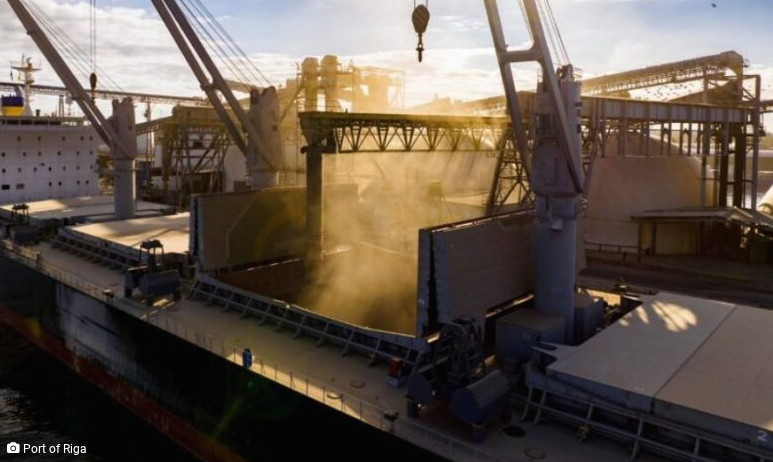
Estonia, Latvia and Lithuania have called for an EU-wide ban on Russian grain transit, seeking to block Moscow from redirecting agricultural exports through European transport networks as disruption in the Black Sea reshapes regional grain flows.
The three countries have submitted a joint letter to European Council president António Costa and European Commission president Ursula von der Leyen, calling for restrictions covering Russian grain moving through EU territory to international markets.
The appeal was signed by Estonian prime minister Kristen Michal, Latvian prime minister Andris Kulbergs and Lithuanian president Gitanas Nausėda.
The Baltic leaders argued that Russia was targeting Ukrainian ports, merchant vessels and transport infrastructure while at the same time looking for alternative routes for its own agricultural exports, including through the Baltic.
The call comes as Russian grain flows are already shifting sharply away from the Black Sea.
Research from IFCHOR Galbraiths shows grain loadings from Russian Baltic and continental ports surged to 1.16m tonnes in September, more than five times the 216,000 tonnes handled in August. Ust-Luga accounted for 545,000 tonnes and Vysotsk another 374,000 tonnes. Over the same period, monitored Russian Black Sea and Azov loadings collapsed from 1.39m tonnes to 201,000 tonnes, lifting the Baltic’s share of combined shipments from 12.6% in August to 80.7% a month later.
The broker said Moscow has been supporting the shift with subsidised rail transport and the conversion of fertiliser and other bulk-handling terminals for grain. Murmansk is also preparing to handle its first grain cargoes this month, although questions remain over infrastructure and the economics of using the northern port.
The trend gives the Baltic governments’ push an added shipping dimension. An EU transit ban would not stop Russian grain moving directly through Russian ports such as Ust-Luga and Vysotsk, but it would close off European ports and transport corridors as alternative gateways as Moscow searches for additional capacity.
Estonia has already moved nationally. Its government earlier this month approved sanctions prohibiting the transit of Russian and Belarusian grain through Estonian ports, covering products falling under the CN 10 commodity group.
Latvia tightened checks on grain origins at its ports in September following increased interest in routing Russian shipments through the country and has also been preparing measures targeting cargo suspected of originating in occupied Ukrainian territory.
The three governments are now pressing Brussels for common rules rather than relying on a patchwork of national restrictions.The changing trade pattern is also coming at a cost.
IFCHOR Galbraiths estimates that moving grain from Baltic Russia to Egypt costs around 30% to 35% more per tonne than shipping from Russia’s traditional Black Sea loading ports, based on freight levels before the latest escalation. Russia has tried to offset the disadvantage through rail subsidies, temporary export-duty relief and priority access for grain on congested northern rail routes.
Longer Baltic voyages towards North African and Mediterranean buyers could provide some support for tonne-mile demand and employment for geared bulkers, but the shift has not made up for the loss of Black Sea volumes.
Total monitored Russian grain loadings across the Black Sea and Azov, Baltic and continental ports and the Far East fell 16% month on month in September, according to the broker.
IFCHOR Galbraiths said logistical bottlenecks and higher costs mean alternative export routes are still struggling to replace the volumes lost through the Black Sea.
Baltic wheat exports could nevertheless rise again this month. The research cites IKAR estimates of as much as 1.8m tonnes moving through the region in October, up from around 1.4m tonnes in September, subject to weather and infrastructure capacity.
The shift follows a sharp deterioration in security across the Black Sea.
IFCHOR Galbraiths noted that several merchant vessels were hit in Romanian and Bulgarian exclusive economic zones in early October, extending attacks beyond areas traditionally viewed as carrying the highest war risk. The Joint War Committee had already widened its Black Sea Listed Area in September, while reported war-risk premiums have climbed from around 0.1% to 0.5% of vessel value over the past two weeks. Some market participants have warned that rates could move towards 1% if conditions deteriorate further.
That is particularly relevant for Ukrainian grain exports. Romanian and Bulgarian ports including Constanta, Varna and Burgas, together with the Danube, have become important alternatives for Ukrainian agricultural cargoes. A further extension of war-risk requirements into currently excluded territorial waters could increase freight and insurance costs and make owners more reluctant to accept regional business.
The Baltic states’ joint appeal also calls for stronger EU-Ukraine Solidarity Lanes and measures to prevent grain originating in occupied Ukrainian territory from entering international markets through European infrastructure.
Michal is expected to raise the proposal at the next European Council meeting.
No EU-wide ban on Russian grain transit has yet been adopted.
Leave feedback about this
You must be logged in to post a review.